
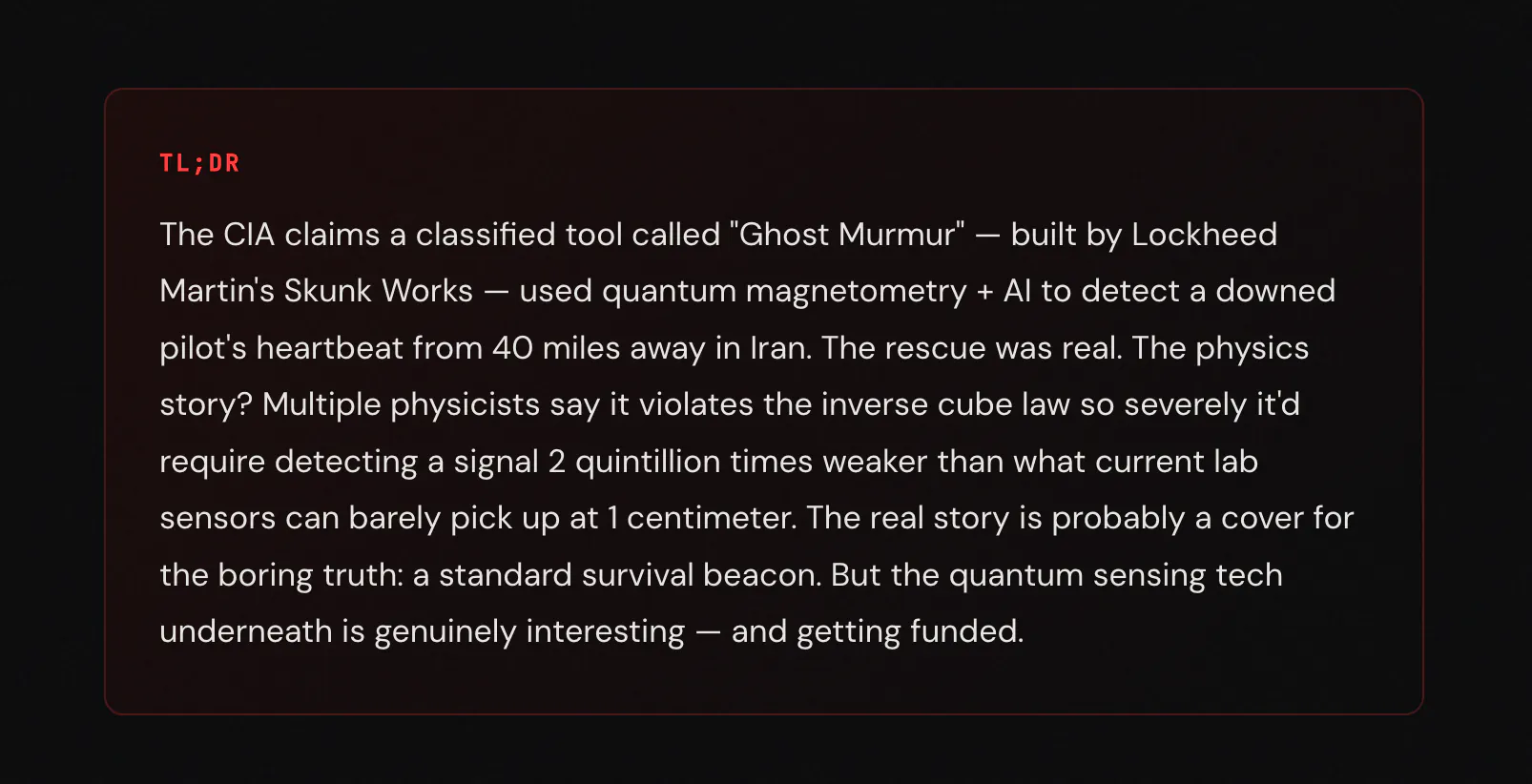
The CIA says it found a downed pilot by listening to his heartbeat through 40 miles of Iranian desert using quantum sensors and AI. Physicists say the math is off by about 2 quintillion. So what's Ghost Murmur actually doing?
What Was Announced: A Secret CIA Tool Heard a Pilot's Heartbeat Through 40 Miles of Desert
On April 7, the New York Post reported that the CIA deployed a classified tool called "Ghost Murmur" to find a downed American airman — callsign "Dude 44 Bravo" — hiding in a mountain crevice in southern Iran. The weapons system officer from an F-15E Strike Eagle had evaded capture for 36 hours, injured, 200 miles deep in hostile territory, armed only with a handgun.
Two unnamed sources told the Post that Ghost Murmur uses "long-range quantum magnetometry" to detect the electromagnetic fingerprint of a human heartbeat, then pairs that with AI to isolate the signal from background noise:
"It's like hearing a voice in a stadium, except the stadium is a thousand square miles of desert. In the right conditions, if your heart is beating, we will find you."— Unnamed source briefed on the program, via NY Post
At a White House briefing the day before, Trump said the CIA spotted the airman from "40 miles away." CIA Director John Ratcliffe said the agency used "exquisite technologies that no other intelligence service in the world possesses" and described the search as "hunting for a single grain of sand in the middle of a desert."
Ghost Murmur was reportedly developed by Lockheed Martin's Skunk Works — the division behind the U-2 and SR-71 Blackbird. Sources said it's been tested on Black Hawk helicopters with plans for F-35 integration. This was its first operational use. The story immediately went massively viral, with influencers breathlessly repeating: "It detects your heartbeat from 40 miles away using AI. Not your phone. Not a tracker. Not a radio signal. Your heartbeat."
The Math That Breaks the Story: Why 40-Mile Heartbeat Detection Violates Known Physics
The heart produces a magnetic field. That's real. The problem is how weak it is, and how fast it dies with distance.
John Wikswo, a professor of biomedical engineering and physics at Vanderbilt University — the first scientist to measure the magnetic field of an isolated nerve — told Scientific American:
"At the surface of the chest, where you're about 10 centimeters away from the source, the magnetic field is just barely detectable. Now, [if] instead of going 10 centimeters away — which is a tenth of a meter — you go a meter away, the amplitude of the signal has dropped to a thousandth of what it was."— John Wikswo, Vanderbilt University
This is the inverse cube law for magnetic dipoles (1/r³). It's Maxwell's equations. It's been validated since the 19th century. Investigative reporter Seth Hettena ran the numbers:
Cardiac magnetic signal at chest surface: ~25 picotesla
Earth's magnetic field: ~50 microtesla (2 million × stronger)
Signal at 10 cm: already 8× weaker
Signal at 1 meter: 8,000× weaker
Signal at 40 miles: ~2 quintillion × weaker (2,000,000,000,000,000,000×)
Claimed scanning area (~18 mi radius): ~190 quadrillion × weaker
As Hettena wrote: "That's not a needle in a haystack, that's an atom in a needle in a haystack."
Chad Orzel, a physics professor at Union College and author of How to Teach Quantum Physics to Your Dog, told Scientific American that even AI pattern matching can't find what isn't there:
"There is really fascinating work being done using quantum magnetometry to measure heart rates. But none of that is something that works over ranges of many miles."— Chad Orzel, Union College
He also pointed out Ghost Murmur would need to distinguish a human heartbeat from "the heartbeats of the sheep and dogs and jackrabbits — whatever else is running around out there." Bradley Roth, a physicist at Oakland University and author of Biomagnetism: The First Sixty Years, agreed: a helicopter-borne version working at distance "would be not just a small advance, but it'd be a revolutionary advance from the state of the art."
What the Lab Research Actually Shows: 1 Centimeter, Shielded Room, 12,000 Heartbeats to Get a Signal
The actual peer-reviewed work using the same diamond magnetometry Ghost Murmur supposedly relies on tells a very different story than the NY Post headline.
A 30-author team published "Human Cardiac Measurements with Diamond Magnetometers" demonstrating non-contact heartbeat detection using NV-center diamond sensors. Three configurations. Shielded and unshielded environments. Sensor sensitivities of 6–26 pT/√Hz with active sensing volumes below 0.5 mm³. The sensors were placed centimeters from the chest. Signals required averaging over hundreds to several thousands of heartbeats. The paper notes: "While the present signals are obtained by averaging, this performance already indicates a clear path toward single-shot MCG sensing." Translation: they're not there yet.
Researchers detected the heartbeat of an anesthetized rat at 5 millimeters from the chest, inside a magnetic shielding cylinder, after an hour of continuous data accumulation.
Ghost Murmur supposedly detected a single beating heart, in real time, from 40 miles, over open desert, from a moving aircraft. Meanwhile, DARPA launched its Robust Quantum Sensors (RoQS) program in August 2025 specifically because quantum sensors remain "notoriously fragile in real-world environments" where "even minor vibrations or electromagnetic interference can degrade performance."
The Phase 1 goal? Get a quantum sensor to keep functioning on a helicopter. DARPA program manager Jonathan Hoffman told Breaking Defense he picked that challenge because "a helicopter in flight is one of the most inhospitable environments for any sensor."
Ghost Murmur supposedly cleared that bar and detected a heartbeat from 40 miles away — eight months later.
The Submarine Problem: Why the "Military Quantum Sensor" Comparison Falls Apart
Some commentators have pointed to military submarine detection via magnetometry as evidence that long-range quantum sensing is plausible. This comparison actually destroys the Ghost Murmur narrative.
Magnetic anomaly detection (MAD) for submarines works because a submarine is thousands of tons of ferromagnetic steel that distorts Earth's existing 50-microtesla magnetic field. You're not detecting the sub's own signal — you're detecting how a massive metal object warps a field that's already there. Even then, China's latest drone-mounted quantum MAD system — which achieved picotesla precision in offshore trials — works at ranges of hundreds of meters to about a kilometer.
A human heartbeat generates ~25 picotesla at the chest surface. A submarine distorts Earth's field by orders of magnitude more. And the sub-detection sensors still need to get within a kilometer. The human heart is a fundamentally different, dramatically weaker target.
As one Hacker News commenter put it: "In an ideal situation, such as being isolated in a desert, detecting the heart within meters is achievable, within a kilometer plausible, within 10s of kilometers implausible."
So What's Ghost Murmur Actually Doing? Follow the DARPA Money, Not the NY Post Source
Here's where this gets interesting. Forget the heartbeat story for a second and look at what Lockheed Martin is actually being funded to build.
In August 2025, DARPA awarded Q-CTRL $24.4 million (A$38M) under the RoQS program to develop next-generation quantum sensors. Lockheed Martin is the subcontractor. The program's focus? Not heartbeat detection. GPS-denied quantum navigation.
Q-CTRL's work centers on "AI-powered software ruggedization" that lets quantum sensors operate on moving defense platforms without traditional shielding. Their Ironstone Opal system has demonstrated 111× greater accuracy than existing inertial navigation in GPS-denied conditions. The system has been field-tested on airborne, maritime, and ground platforms. Lockheed Martin's Thomas Loftus called it "transformational national security capabilities that complement GPS."
Separately, Lockheed Martin and Q-CTRL were awarded a DIU (Defense Innovation Unit) contract to prototype a quantum-enabled Inertial Navigation System. The applications listed by DARPA for RoQS Phase 2 include ground vehicles, submarines, satellites, and UAVs — platforms that need precision positioning when GPS is jammed, spoofed, or unavailable.
Now consider the actual operational scenario in Iran: you have a known crash location, a known time window, a relatively bounded search area in low-clutter desert terrain, and an airman who activated a Combat Survivor Evader Locator (CSEL) beacon — a Boeing-made RF device that transmits a radio signal designed for long-range detection. Standard military equipment since 2009.
A quantum-enhanced magnetic navigation/mapping system, operating in GPS-denied airspace deep inside Iran, combined with a standard survival beacon? That's a plausible technology stack. It's impressive. It's just not "hearing a heartbeat from 40 miles away."
The Boring Explanation vs. the Movie Tagline: What the NY Post's Own Story Reveals
Buried in the same Post article that launched the Ghost Murmur frenzy is this line from their own source: "He had to come out [of the crevice] to send the beacon. It was less important the signal they sent and more important that he had to come out to send [it]."
Read that again. The source is saying the beacon mattered — specifically, the moment the airman emerged from cover to activate it. Radio waves are detectable from orbit. That's not quantum physics. That's just physics.
Chad Orzel has a theory about why the Ghost Murmur story exists at all:
"Somebody yanking a reporter's chain. It could be a snarky, clever way to say, 'Of course, I'm not going to tell you how we figured this out' — or a piece of disinformation to fool somebody into thinking that we actually have this secret technology."— Chad Orzel, via Scientific American
There's a third option the physics professors aren't positioned to offer: the CIA used a genuinely advanced quantum navigation/sensing tool to operate deep in Iranian airspace, and the "heartbeat detection" narrative was grafted onto it because it makes a better story — and because explaining GPS-denied quantum inertial navigation doesn't play as well at a White House press briefing.
Trump's own phrasing supports this reading. He told the press the CIA spotted the airman from "40 miles away" — but "spotted" doesn't necessarily mean "detected his heartbeat." The Newsweek report notes it was "not clear whether that figure referred to the tool's initial detection range or a subsequent observation."
The Real Tech Stack That Builders Should Actually Care About
Strip away the 40-mile heartbeat fantasy, and there's a genuinely important technology convergence happening underneath.
NV-diamond magnetometry is moving out of labs. The January 2026 arXiv paper demonstrated that NV sensors with sensing volumes below 0.5 mm³ can achieve sensitivities of 6–26 pT/√Hz at room temperature. The compact, no-cryogenics angle is the breakthrough. Traditional SQUID magnetometers require cooling to near absolute zero. NV-diamond sensors work at room temperature, in a probe volume of 2.7 cm³. That's the difference between a $2M lab instrument and a deployable field device.
AI-powered sensor ruggedization is the real product. Q-CTRL's core proposition isn't better quantum hardware — it's software that makes fragile quantum sensors work in hostile environments. Their AI compensates for vibration, electromagnetic interference, and platform motion without physical shielding. DARPA's Jonathan Hoffman described the goal as a "philosophical, foundational change in how we build quantum sensors" — not band-aids like shielding, but architectures that reject interference by design.
Quantum magnetic navigation is the killer app nobody's tweeting about. NATO's Joint Air Power Competence Centre describes quantum magnetometers as capable of detecting submarines at "several kilometers, significantly farther than classical magnetometers." SandboxAQ's AQNav — a quantum magnetometry-aided navigation system — has been successfully tested by the USAF on various aircraft for real-time, unjammable navigation. When GPS gets jammed — which is increasingly common in contested airspace — you navigate by matching local magnetic and gravitational field readings to pre-mapped anomaly databases. That's the actual defense use case getting funded.
China is sprinting. In April 2025, Chinese researchers flight-tested a drone-mounted CPT atomic magnetometer for submarine detection, achieving 0.849 nT accuracy after correction — matching NATO's MAD-XR system at lower cost. This is a real quantum sensing arms race, and it's about navigation and magnetic anomaly detection, not heartbeat tracking.
The Bigger Picture: How "AI + Quantum + Classified" Becomes Unfalsifiable Hype
The Ghost Murmur episode is a case study in how narratives exploit the gap between "technically real concept" and "operational reality" — and how sprinkling "AI" on any claim makes it almost impossible for non-experts to push back.
Within hours of the NY Post story, viral social posts were confidently explaining how "AI detects your heartbeat from 40 miles away" as established fact. The LinkedIn thought-leader circuit was already mining it for engagement. International media from India to Belarus ran it straight. The handful who checked the physics — Scientific American, The Quantum Insider, Seth Hettena's Substack, a few HN commenters — were drowned out by volume.
The pattern is: take a real technology. Attach it to a dramatic story. Sprinkle "AI" on top. Claim capabilities 15+ orders of magnitude beyond demonstrated reality. The classification label makes it unfalsifiable — "maybe it's classified and that's why the public research doesn't match."
This matters for anyone building in AI or deep tech. When the public can't distinguish between "AI helps filter sensor noise at close range" and "AI detects heartbeats through 40 miles of atmosphere," you get distorted funding, inflated expectations, and inevitable backlash.
The Quantum Insider put it carefully: "using such systems in open, noisy environments — and at meaningful distances — would represent a significant leap beyond current demonstrated capabilities, suggesting the reports may overstate the maturity or range of the technology."
That's a polite way of saying the physics doesn't work.
The rescue was real. The airman is home. The quantum sensing field is real, advancing, and getting serious defense funding. But Ghost Murmur — at least the version sold to the public — looks a lot more like information warfare than information technology. The more interesting question isn't whether the CIA can hear your heartbeat from 40 miles away. It's what quantum navigation tools they used to fly deep into Iranian airspace without GPS, find their guy, and get out — and why the heartbeat story made better cover than the truth.